THE BEAUTIFUL GAME AT WAR
NATIONAL WWI MUSEUM AND MEMORIAL
THE BEAUTIFUL
GAME AT WAR
GAME AT WAR
Football and the Great War, 1914–1919
From the Christmas Truce to the Footballers’ Battalions, football was woven into every chapter of the Great War — on the pitch, in the trenches, and on the home front.
NATIONAL WWI MUSEUM AND MEMORIAL • KANSAS CITY
01The Beautiful Game at WarIntro • 36″×84″
FOOTBALL & THE MILITARY
A SOLDIER’S
GAME
GAME
Before the war, football was already embedded in British military life. Nearly every regiment had a team. The game built fitness, unit cohesion, and the spirit of competition commanders believed would carry into battle.
500,000+
British soldiers played organized football
02A Soldier’s GameMontera • 23″×84″
THE CHRISTMAS TRUCE
DECEMBER 1914
THE
CHRISTMAS
TRUCE
CHRISTMAS
TRUCE
When enemies became teammates
In the winter of 1914, along the Western Front, something extraordinary happened. Soldiers laid down their weapons and walked into no man’s land — not to fight, but to play.
03The Christmas TruceIntro • 36″×84″
CHRISTMAS DAY 1914
SILENT
NIGHT
NIGHT
On Christmas Day 1914, along stretches of the Western Front, German and British soldiers emerged from their trenches. They exchanged cigarettes, sang carols together, and — by many accounts — played football in no man’s land.
“The game started about mid-day with about 50 a side, and lasted about an hour. The game ended in a draw, 3–3.”
— Ernie Williams, 6th Cheshires
04Silent NightMontera • 23″×84″
KICK AND RUSH
FOOTBALL AS WEAPON
KICK
AND RUSH
AND RUSH
When the ball led the charge
On multiple occasions during the war, soldiers kicked footballs across no man’s land as they advanced — acts of bravado that became legendary.
05Kick and RushIntro • 36″×84″
ARTIFACT • ON LOAN
THE LOOS
FOOTBALL
FOOTBALL
On September 25, 1915, Rifleman Frank Edwards of the London Irish Rifles kicked a football across no man’s land as the signal to advance at the Battle of Loos. The ball, riddled with shrapnel, survived.
Now on loan to the National WWI Museum
06The Loos FootballMontera • 23″×84″
THEY ANSWERED THE CALL
HEARTS OF MIDLOTHIAN
McCRAE’S
BATTALION
BATTALION
In November 1914, Heart of Midlothian FC was leading the Scottish First Division. Eleven first-team players enlisted together in Sir George McCrae’s 16th Royal Scots — the first British football club to answer the call.
7
Hearts players killed in action
07McCrae’s BattalionMontera • 23″×84″
WOMEN’S FOOTBALL
MUNITIONETTES
With men at the front, women filled factory floors — and formed football teams. The Dick, Kerr Ladies FC of Preston became legends, raising thousands for war charities and drawing record-breaking crowds.
53,000
Spectators at Goodison Park, 1920
08MunitionettesMontera • 23″×84″
FLAGS & LEGACY
THE NATIONS
FLAGS
AT WAR
AT WAR
Football transcended borders. Every army played the game — from the Western Front to Gallipoli.
United Kingdom
France
German Empire
Belgium
United States
Australia
09Flags at WarMontera • 23″×84″
LEST WE FORGET
REMEMBRANCE
“The beautiful game carried men through the darkest days. It was their joy, their comfort, and for some, their last act of defiance.”
— Alexander Jackson, Historian
Football did not win the war. But it sustained the men who fought it — giving them a reason to laugh, a reason to run, and a memory of the world they hoped to return to.
10RemembranceMontera • 23″×84″
THE NATIONS AT WAR
17TH MIDDLESEX REGIMENT
THE FOOTBALLERS’
BATTALION
BATTALION
Formed in December 1914, the 17th Service Battalion of the Middlesex Regiment was recruited from professional footballers. Stars from Clapton Orient, Tottenham, and Chelsea marched together into the trenches.
600+
Professional footballers enlisted
“Pals battalions” like the 17th drew men who trained together, played together, and fought together — and too often, died together.
11The Footballers’ BattalionMontera • 23″×84″
FRANCE
LES POILUS
French soldiers — nicknamed “les poilus” (the hairy ones) — played football in rest camps behind the lines. The game provided a brief escape from the brutality of Verdun and the Somme.
“We kicked the ball between shell holes. For twenty minutes, we forgot the war entirely.”
— French infantryman, Verdun, 1916
French football clubs lost entire generations. Racing Club de France, Red Star, and Stade Français each lost dozens of members to the conflict.
12Les PoilusMontera • 23″×84″
THE SOMME • JULY 1, 1916
THE EAST
SURREY
FOOTBALLS
SURREY
FOOTBALLS
Captain W.P. Nevill purchased four footballs for his platoons, each inscribed. At zero hour on July 1, 1916, he kicked one toward the German lines and led his men over the top.
“The Great European Cup Final — East Surreys v. Bavarians. Kick off at zero.”
Captain Nevill was killed within minutes. His men carried the footballs forward.
13The East Surrey FootballsMontera • 23″×84″
AUSTRALIA & NEW ZEALAND
FOR KING
AND EMPIRE
AND EMPIRE
Australian and New Zealand soldiers brought football to Gallipoli and the Western Front. The ANZAC troops played both rugby and association football in rest areas, on beaches, and even within range of enemy fire.
In 1916, an “Australian Imperial Force XI” toured England, playing charity matches against English clubs to raise funds for wounded soldiers. Football knit the Empire together across 10,000 miles.
14For King and EmpireMontera • 23″×84″
PARIS 1919
THE INTER-
ALLIED
GAMES
ALLIED
GAMES
In June–July 1919, General Pershing organized the Inter-Allied Games at a purpose-built stadium in Paris. Over 1,500 athletes from 18 Allied nations competed — a precursor to the modern military Olympics.
18
Nations competed at Pershing Stadium
Football was among the marquee events. The tournament demonstrated that sport could heal the wounds of war and forge new bonds between former allies.
15The Inter-Allied GamesMontera • 23″×84″
GERMAN EMPIRE
WEIHNACHTSFRIEDEN
German soldiers called it “Weihnachtsfrieden” — the Christmas Peace. Their letters home describe the same wonder as their British counterparts: singing, gift-giving, and football in no man’s land.
“We fraternized with the English. We exchanged buttons, tobacco, and cigarettes. Then someone produced a football and we played until it grew dark.”
— Lt. Kurt Zehmisch, 134th Saxons
Football was as central to German military culture as it was to the British. Many German regiments had organized clubs, and the sport provided common ground with the enemy across the wire.
16WeihnachtsfriedenMontera • 23″×84″
PHOTOGRAPHS

NORTHERN FRANCE • 1916
GAS
MASKS XI
MASKS XI
A British football team poses for a photograph in full gas masks. The game continued — even when the air itself became a weapon.
PHOTO: AGENCE ROL / BIBLIOTHÈQUE NATIONALE DE FRANCE / PUBLIC DOMAIN
P1Gas Masks XIMontera • 23″×84″

SALONIKA • CHRISTMAS 1915
CHRISTMAS
FOOTBALL
FOOTBALL
Officers and men of the 26th Divisional Ammunition Train play football on Christmas Day, 1915 — one of the most reproduced photographs of the war.
PHOTO: IMPERIAL WAR MUSEUM / IWM Q 31576 / PUBLIC DOMAIN
P2Christmas FootballMontera • 23″×84″

WESTERN FRONT • 25 DEC 1914
THE
TRUCE
TRUCE
British and German officers meet in no man’s land during the unofficial Christmas Truce. Northumberland Hussars, 7th Division, Bridoux-Rouge Banc Sector.
PHOTO: IMPERIAL WAR MUSEUM / IWM Q 50721 / PUBLIC DOMAIN
P3The TruceMontera • 23″×84″

ILLUSTRATED LONDON NEWS • 1915
THE
ILLUSTRATED
WAR
ILLUSTRATED
WAR
Published January 9, 1915: “The light of Peace in the trenches on Christmas Eve.” The public first learned of the truce through illustrations like these by Frederic Villiers.
ILLUSTRATION: FREDERIC VILLIERS / ILLUSTRATED LONDON NEWS / PUBLIC DOMAIN
P4The Illustrated WarMontera • 23″×84″

RECRUITMENT • 1914
JOIN THE
BATTALION
BATTALION
Recruitment posters targeted footballers and supporters alike. “Do you want to be a Chelsea Die-Hard?” The Football Association suspended the league in 1915.
PHOTO: UK CROWN COPYRIGHT / PUBLIC DOMAIN
P5Join the BattalionMontera • 23″×84″

WOMEN’S FOOTBALL
DICK, KERR
LADIES
LADIES
Formed at the Dick, Kerr munitions factory in Preston during WWI, they became the most famous women’s football team in the world — until the FA banned women from its pitches in 1921.
PHOTO: UNKNOWN / PUBLIC DOMAIN
P6Dick, Kerr LadiesMontera • 23″×84″

FOOTBALLER • OFFICER • PIONEER
WALTER
TULL
TULL
Tottenham Hotspur and Northampton Town player. First Black officer to lead white troops in the British Army. Killed in action at the Second Battle of the Somme, March 1918.
PHOTO: TOTTENHAM HOTSPUR ARCHIVES / PUBLIC DOMAIN
P7Walter TullMontera • 23″×84″
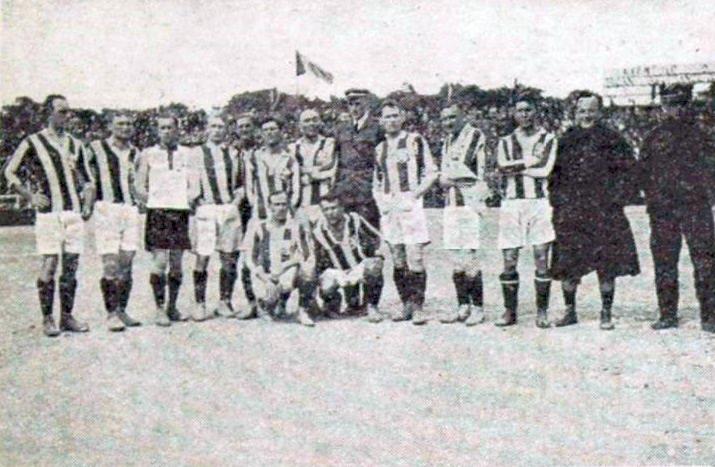
INTER-ALLIED GAMES • PARIS 1919
THE
VICTORS
VICTORS
The Czechoslovak football team defeated France 3–2 in the final of the 1919 Inter-Allied Games at Pershing Stadium, Paris. A new nation, born from the war, triumphant on the pitch.
PHOTO: LA VIE AU GRAND AIR / 1919 / PUBLIC DOMAIN
P8The VictorsMontera • 23″×84″
FLAG & PHOTO SECTIONS
SECTION IV
ANSWERING
THE CALL
THE CALL
Football’s Volunteers and the
17th Middlesex Regiment
17th Middlesex Regiment
When war came, professional footballers faced a choice: continue playing or answer their country’s call. The 17th Service Battalion of the Middlesex Regiment — the “Footballers’ Battalion” — became a symbol of sporting sacrifice.
17Answering the CallSection Intro • 36″×84″

SECTION V
THE
WORLD’S
GAME
WORLD’S
GAME
Football Across the Lines —
From Flanders to the Dardanelles
From Flanders to the Dardanelles
Football was not merely a British pastime. Soldiers from France, Belgium, Germany, and the Ottoman Empire all played behind the lines. The game transcended language and allegiance — a shared grammar of rest and resilience.
18The World’s GameSection Intro • 36″×84″
SECTION VI
OVER
THERE
THERE
American Football, Soccer, and the
Doughboys at the Front
Doughboys at the Front
When the American Expeditionary Forces arrived in France in 1917, they brought their own football — the gridiron game. But soccer, too, found its way into American military life. The Inter-Allied Games of 1919 crowned a new kind of champion.
19Over ThereSection Intro • 36″×84″
BACKDROPS
No Man’s
Land
Land
The pitch had no lines, the goals were made of greatcoats, and the referee was a sergeant — but for one afternoon, the game was all that mattered.
B1No Man’s Land MatchBackdrop • 120″×89″
The Kit
Room
Room
Artifacts of the beautiful game — carried from the pitch to the trenches and back again.
B2The Kit RoomBackdrop • 120″×89″
December 25, 1914
The
Christmas
Truce
Christmas
Truce
“We played them at football. They beat us 3–2.”
PHOTOGRAPH: IMPERIAL WAR MUSEUM / IWM Q 50721 / PUBLIC DOMAIN
B3The Christmas TruceBackdrop • 120″×89″
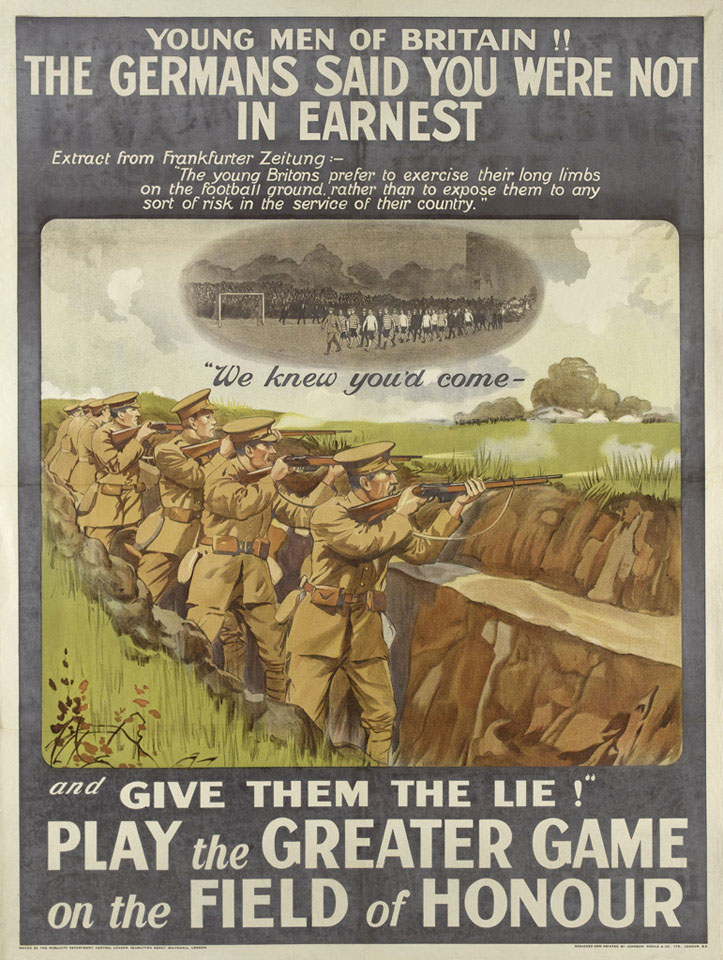
The
Recruitment
Wall
Recruitment
Wall
“Do you want to be a Chelsea Die-Hard? If so, join the 17th Btn. Middlesex Regt. and follow the lead given by your favourite Football Players.”
Recruitment Posters • 1914–1916
B4The Recruitment WallBackdrop • 120″×89″
Preston • 1917–1965
Dick, Kerr
Ladies
Ladies
Factory workers who became the most famous women’s football team in history. Their Boxing Day 1920 match drew 53,000 spectators — until the FA banned women from playing on league grounds in 1921.
PHOTOGRAPH: NATIONAL FOOTBALL MUSEUM / PUBLIC DOMAIN
B5Dick, Kerr LadiesBackdrop • 120″×89″